Where Your Exchange Funds Sit
And why, for Olympic Exchange clients, no one — including us — can move them without your written consent.
How Your Funds Are Held
When you complete a 1031 exchange with Olympic Exchange Accommodators, your sale proceeds are deposited into a Qualified Escrow Account at Columbia Bank, established under your own name and your own taxpayer identification number — not pooled with other clients' funds, not routed through our general operating account.
The account is governed by a written Qualified Escrow Agreement among you, Olympic Exchange, and Columbia Bank. Under that agreement:
- Every disbursement requires dual, independent authentication — Olympic Exchange initiates, and you (the exchanger) must separately authorize before Columbia Bank releases any funds.
- You receive written notification of exactly how and where your funds have been deposited, including account identifiers.
- You receive written instructions on how to verify that deposit independently, directly with Columbia Bank.
- Funds are held at Columbia Bank, an FDIC-insured institution. Standard FDIC insurance applies up to $250,000 per depositor; for balances above that threshold, Columbia Bank's sweep program is available as an optional service to extend coverage.
This structure is recognized in IRS Treasury Regulation §1.1031(k)-1(g)(3) and is one of the two compliance paths permitted under Washington State law RCW 19.310.040.
The defining feature: even Olympic Exchange itself cannot move your funds without your authorization. The structure is prophylactic, not remedial — designed to prevent loss rather than to compensate after one occurs.
How This Statute Came to Be
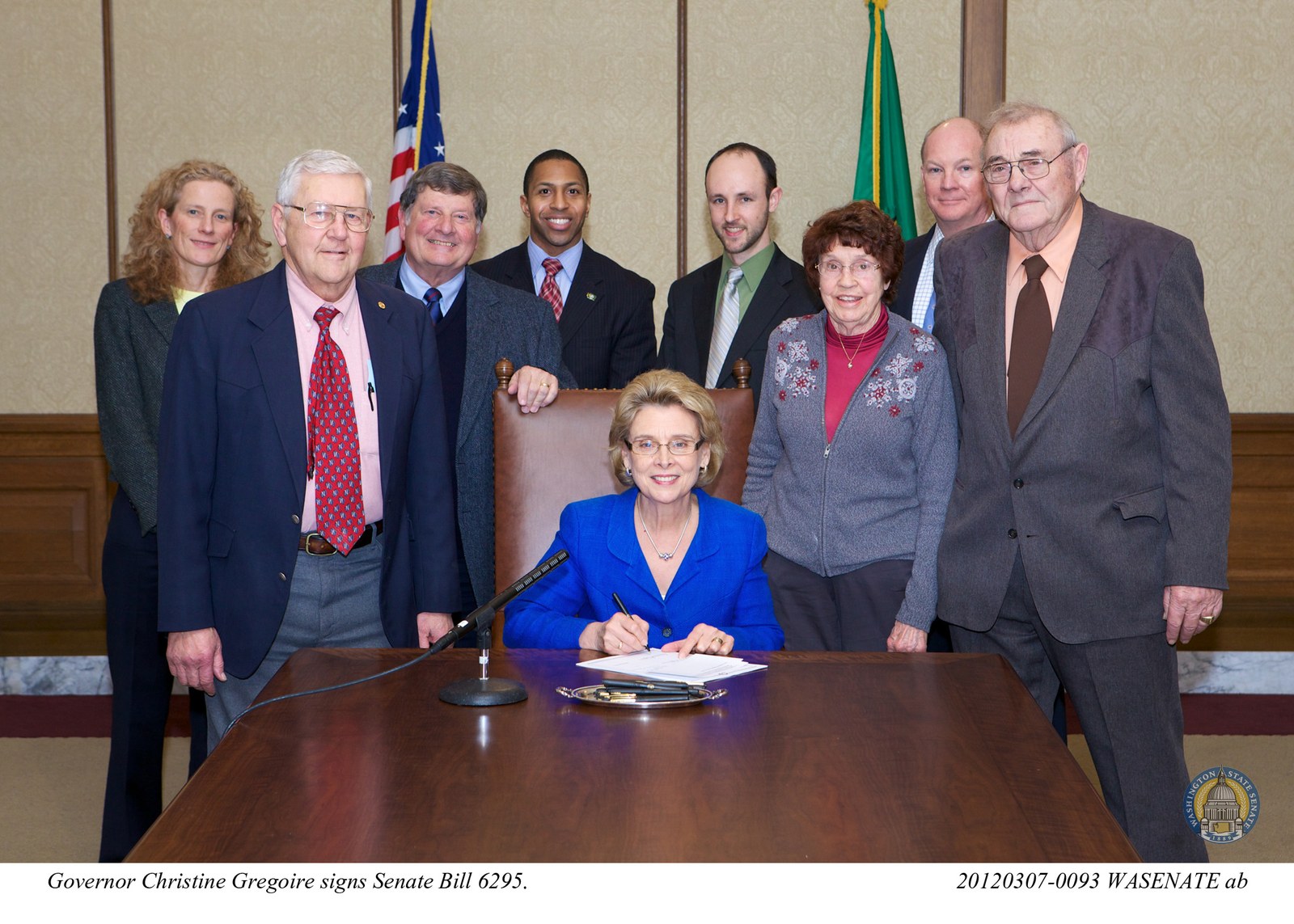
Washington's current exchange-facilitator statute exists because of a 2010–2011 fraud committed by a Central Washington CPA who also operated as a Qualified Intermediary. He diverted client exchange funds into a personal real estate investment outside the state and was later prosecuted, convicted, and declared bankruptcy. Among his victims was an elderly ranching couple from Senator Morton's rural Northeast Washington district — longtime constituents who had trusted a professional and lost their investment.
In January 2012, Senator Morton introduced SB 6295 in response. The original bill was well-intentioned but unworkable: it would have required every exchange facilitator in Washington to maintain a $50 million fidelity bond. No such bond product existed in the insurance market at any price. Every small and mid-sized QI in the state would have been forced out of business overnight, leaving only the largest national firms.
The hearing itself had been set on the Senate calendar the evening before with essentially no notice to the exchange-facilitator community. Mary Foster of 1031 Services in Seattle — one of the most experienced QIs in the Pacific Northwest — learned of it that morning and immediately called Jeff Helsdon. By the time Jeff reached Olympia, the hearing had already begun; the ranchers' testimony was already underway. At the hearing, one testifier reported losing approximately $850,000 to a “white collar criminal” exchange facilitator. Jeff signed in at the witness table.
The committee was sympathetic to the victims, and the chair's introduction of the industry witness was openly cynical: “Next we have a QI testifying against the bill … this should be interesting.”
What followed was a two-minute education on Qualified Escrow — how it is recognized in the 1991 Treasury Regulations for Section 1031 as a safe harbor, set out as an alternative to the Qualified Intermediary safe harbor, and how Olympic is unique in layering both safe harbors together for maximum client protection. He explained why Qualified Escrow is structurally safer for clients than any bond, and that the proposed $50 million bond simply did not exist as an insurance product. By the end of the testimony, the hostility in the room had receded. The committee chair decided not to advance the original bill, but instead to convene a stakeholder task force to rewrite it.
That task force — which met in Olympia over the following weeks — included Mary Foster, Dennis Helmick, Jeff Helsdon, and representatives from the Department of Financial Institutions, the Office of the Insurance Commissioner, and industry stakeholders. The substantive redrafting of the bill owed most to Mary and Dennis; Jeff's specific contribution was the criminal penalty provisions (Class B felony for prima facie fraud) that appear in the statute as enacted. All of the task force participants contributed to the final language.
SB 6295 was signed into law by Governor Gregoire on March 7, 2012. The $50 million bond requirement did not survive. In its place, the statute gave exchange facilitators a choice: a $1 million fidelity bond covering criminal acts, OR a Qualified Escrow Account requiring client consent for every withdrawal.
Olympic Exchange operates under the Qualified Escrow option. We believe it is the better structure for our clients. The sections that follow explain why — and disclose, in the statute's exact language, what Washington law requires us to tell you.
Washington State Exchange Facilitator Disclosure
Required by RCW 19.310.040
Washington state law, RCW 19.310.040, requires an exchange facilitator to either maintain a fidelity bond in an amount of not less than one million dollars that protects clients against losses caused by criminal acts of the exchange facilitator, or to hold all client funds in a qualified escrow account or qualified trust that requires your consent for withdrawals. All exchange funds must be deposited in a separately identified account using your taxpayer identification number. You must receive written notification of how your exchange funds have been deposited. Your exchange facilitator is required to provide you with written directions of how to independently verify the deposit of the exchange funds. Exchange facilitation services are not regulated by any agency of the state of Washington or of the United States government. It is your responsibility to determine that your exchange funds will be held in a safe manner.
How Olympic Complies
| The Statute Requires | Olympic Exchange's Implementation |
|---|---|
| EITHER a $1M fidelity bond OR a qualified escrow account requiring client consent for withdrawals | Qualified Escrow Account at Columbia Bank — every wire requires separate, independent authentication by both Olympic and the client |
| Funds deposited in a separately identified account using the client's TIN | Each client receives an individually-titled account under their own TIN — never pooled, never commingled |
| Written notification of how funds have been deposited | Provided in the Qualified Escrow Agreement and confirmed by Columbia Bank's account-opening documentation |
| Written directions on how to independently verify the deposit | Provided in the engagement package, including Columbia Bank contact information for direct verification |
| Acknowledgment that exchange facilitation is unregulated | Acknowledged above in the statutory disclosure |
| Client responsibility to determine funds are held safely | We encourage every client to verify their account directly with Columbia Bank |
Why We Use Qualified Escrow
The statute permits two protective structures: a fidelity bond, or a Qualified Escrow account. Olympic Exchange uses Qualified Escrow because, in our judgment, it provides clients better protection.
A fidelity bond is remedial — if a loss occurs, the client files a claim and waits to recover from the bonding company through investigation, possible denial, and potentially litigation. A Qualified Escrow account is prophylactic — the structure prevents unilateral access to client funds in the first place. Even Olympic Exchange itself cannot move your money without your authorization.
Time also matters. In a 1031 exchange, the 45-day identification deadline and the 180-day exchange deadline cannot be extended — not for any reason, including theft or litigation. A fraud loss that triggered a bond claim could leave the client without funds, outside the exchange window, and owing tax on a gain they never received. Prevention is a more reliable form of protection than compensation.
That reasoning — prevention over compensation — was the core of the testimony delivered in January 2012. It is also the core of how we choose to hold client money today.
What a Fidelity Bond Does — and Doesn't — Protect
Most exchange facilitators in Washington choose the fidelity bond path. Understanding its limitations is essential to evaluating your own fund safety.
The Principal Exclusion Problem
Many fidelity bond policies exclude losses caused by the owners, principals, or officers of the insured company. In an industry where many QIs are small, owner-operated businesses, the bond may not cover the most dangerous category of fraud — theft by the person who controls the firm.
The Coverage Limit Problem
The statutory minimum is $1 million. For a commercial exchange involving $3 million, $5 million, or $9 million in proceeds, a $1 million bond covers a fraction of the exposure. If the bond is aggregate rather than per-occurrence, that million is the total available for all claims combined.
The Timing Problem
A fidelity bond is remedial — it pays after the loss occurs. In a 1031 exchange, the 45-day identification deadline and 180-day exchange deadline cannot be extended for any reason, including theft. A fraud loss during an active exchange could leave you without funds and outside your exchange window, owing tax on gain you never received.
How to Independently Verify Your Funds
Per RCW 19.310.040 and our engagement package, you have the right and the means to verify your deposit directly:
Account confirmation
Provided by Columbia Bank when your account is opened
Direct contact with Columbia Bank
Columbia Bank contact information is provided in your engagement package so you can verify your account directly
Online banking access
You receive credentials to view your account directly
Statements
Copies provided with each closing
Verification isn't merely permitted — it's expected. We want you to see for yourself.
Why These Protections Exist: The LandAmerica Collapse
In 2008, LandAmerica 1031 Exchange Services filed for bankruptcy, freezing $420 million in exchange funds from 450 customers. Every exchange failed. Clients with commingled accounts became general unsecured creditors — and after taxes, legal fees, and five years of litigation, recovered roughly 40 cents on the dollar. The 50 clients whose funds were in segregated accounts recovered in full.
Jeff Helsdon was there. He knew the people involved. The protections described on this page — Qualified Escrow, segregated accounts, dual-signature controls — are a direct response to what happened.
Read the full LandAmerica storyQuestions about how your funds are held?
Our consultation fee is $0. We'll walk you through the Qualified Escrow Agreement, the verification process, and the legislative history — in plain English.